A renowned Cameroonian environmental activist and social forester, Dr. Cecile Ndjebet, has been awarded the prestigious Kew International Medal for her tireless efforts in advocating women’s rights in forest communities. She received the award at the Royal Botanic Gardens (RBG) in London, United Kingdom recently.
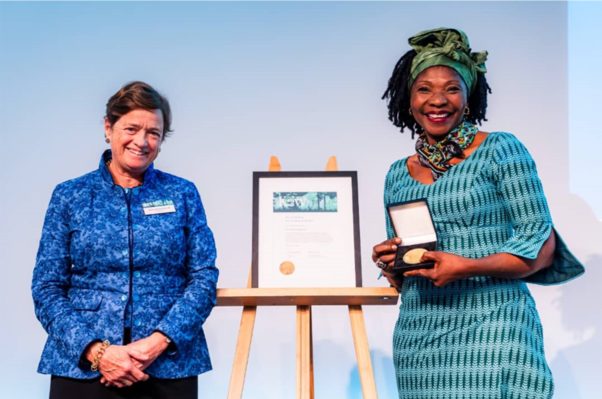
“My vision is a world where we are successfully halting temperature increase and living in harmony with nature. Here, women and Indigenous Peoples take their rightful seat at the table to take action, and youth are taken seriously,” Dr. Ndjebet told the press after receiving the award.
“Receiving the Kew International Medal is very important to me – it shows high recognition of what I’m doing together with my fellow rural women and the women and girls involved in my African community forest management network. I hope it will mean more engagement, motivation, and commitment to restoring African degraded ecosystems to help us become more resilient to climate change and enhance the livelihoods of our local communities. The world is experiencing the most challenging time in human history, and we must succeed together in safeguarding the planet,” she added.
The Head of Interpretation at RBG Kew, Dr. Sharon Willoughby, lauded Dr. Ndjebet for her achievements. Hear her: “I first encountered Cécile’s extraordinary work when researching content for the Cameroon Orchids Festival at Kew in 2023. I felt that her work was extremely inspiring with strong alignment to Kew’s values and the changes we are seeking to make in the world – putting people at the heart of protecting nature. I am thrilled that Cécile is this year’s Kew International Medal Winner,” he said.
Richard Deverell, Director of RBG Kew, added: “We are thrilled to select Cécile for this year’s medal for her commitment to protecting biodiversity for the benefit of people and planet, in close alignment with Kew’s own mission. Ndjebet has garnered global recognition for her tireless work on the ground to conserve the incredible biodiverse forests in Cameroon whilst simultaneously improving the lives of women by campaigning for their right to own and manage land.”
The Cameroon’s High Commissioner in London, H.E. Albert Njoteh Fotabong, was represented at the event by a delegation of four officials from the Mission, led by the Minister Counsellor, Mrs. Pauline Hieh.
Established in 1992, the prestigious Kew International Medal is an award given to outstanding individuals who have received international recognition for achievements closely aligned with Kew’s mission to understand and protect plants and fungi, for the wellbeing of people and the future of all life on Earth. Previous award winners have included Sir David Attenborough (1996), President Juan Manuel Santos Calderón (2017), Mary Robinson (2019), Sir Partha Dasgupta (2021), and Professor Suzanne Simard (2023).
Dr. Cécile Ndjebet’s impressive list of accolades continues to grow. In 2022, she was honored with not one, but two prestigious awards:The UN Champion of the Earth award from the United Nations Environment Programme, recognizing her outstanding contributions to environmental conservation. The Wangari Maathai Forest Champion Award, acknowledging her tireless efforts in promoting sustainable forest management and advocating for women’s rights in forest communities.
And in 2023, Dr. Ndjebet added another feather to her cap by becoming the joint winner of the esteemed Gulbenkian Prize for Humanity. The Gulbenkian award jury was chaired by former German Chancellor, Angela Merkel.
This recognition crowns her outstanding work in promoting gender equality in forest management and conservation across Africa. Kew International is a UK-based international organization plays a leading role in plant and fungal conservation. Growing up in a forest community in Cameroon, Dr. Cecile Ndjebet developed a deep love and respect for nature. She has dedicated her career to improving conservation and livelihoods through mobilizing women to support themselves through agro-forestry initiati
Dr. Ndjebet’s work has focused on empowering women in rural Cameroon, where around 70 percent of women live in rural areas and depend on forests and wild produce for their livelihoods. Despite their crucial role, women in some communities are denied the right to own or inherit forested land. Dr. Ndjebet says she has worked tirelessly to change this narrative, co-founding the African Women’s Network for Community Management of Forests in 2009, which now has representation from 20 countries across Africa. Recently, in her native Edea in the Littoral Region, she kick-started the handing over of land ownership attestations to women by their husbands. This initiative is supported by traditional authorities and government officials.